
หมวดหมู่
บล็อกใหม่
RS485 PH₃ Gas Sensor Selection Guide: From Measuring Range to Communication Protocol
September 16 , 2026
Phosphine (PH₃) detection is increasingly common in industrial safety, agricultural production and environmental monitoring. With a wide variety of gas sensors available on the market, how to select a suitable RS485 PH₃ sensor? The key points below can serve as your reference.
Clarify the on-site PH₃ concentration range before selection. This sensor adopts an electrochemical principle, with a measuring range of 0~1000 ppm and a resolution of 0.1 ppm, ideal for scenarios requiring high-precision monitoring. If the on-site concentration frequently approaches or exceeds the upper limit of the range, select a model with a wider measuring range or higher protection grade.
The device is equipped with an RS485 interface and supports standard ModBus RTU protocol. Default address: 0x01; default baud rate: 9600 bit/s; 8 data bits, no parity, 1 stop bit, CRC check. Before use, verify that your PLC, configuration software or data acquisition terminal supports ModBus RTU. Note that the A/B wires must not be reversed. When networking multiple devices, avoid duplicate addresses. A 120 Ω terminating resistor or RS485 repeater may be added if necessary.
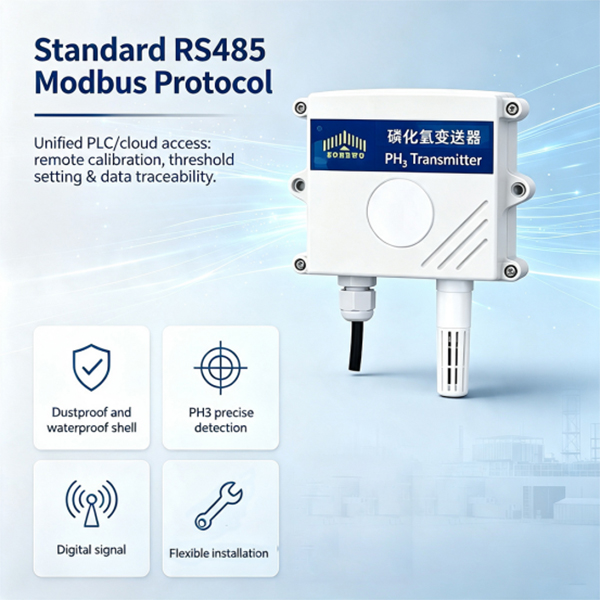
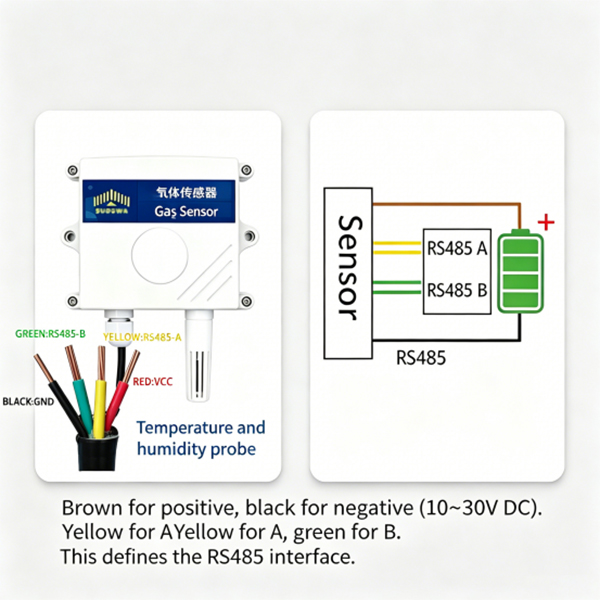
The device supports wide DC power input of 5~28 VDC, compatible with various on-site DC power supplies. Wiring definition: Brown (or Red) → Power Positive; Black → Power Negative; Yellow → RS485-A; Green → RS485-B. The sensor comes with a wall-mounted waterproof housing, dimension approx. 110 × 85 × 44 mm for wall installation. Avoid locations with strong air convection, organic solvents, corrosive gases or high-concentration alkaline gases, or reinforce protection measures. Otherwise, sensor service life and zero-point stability may be impaired.
The sensor integrates temperature and humidity monitoring: temperature range -40~+80 ℃ with accuracy ±0.3 ℃; humidity range 0~99.9 %RH. Recommended operating environment: -20~50 ℃, 15%~90%RH non-condensing. Long-term operation under high humidity is not recommended. Data refresh interval: ~2 seconds. Typical sensor service life: less than 2 years. It supports zero-point calibration, modification of device address and baud rate, facilitating maintenance.
This product applies to industrial safety, agricultural production, environmental monitoring and other fields. However, the manual clearly states: Do NOT use it for life safety systems. Perform regular calibration after installation. If the sensor has been idle for a long time, conduct 24-hour aging before use. Keep it away from high-concentration organic gases, corrosive gases and strongly alkaline environments during operation.
When selecting an RS485 PH₃ sensor, match the measuring range, protocol, power supply, environmental conditions and maintenance requirements. Only by cross-checking on-site requirements against product parameters item by item can you obtain a stable, reliable and easily integrated PH₃ monitoring solution.https://www.zonewuiot.com/rs485_c17

โทร : +86 18146178586
Whatsapp : +86 18146178586
อีเมล : qui@zonewu.com
เพิ่ม : 1501-3, Building F03, Phase III, Software Park, Jimei District, Xiamen City, Fujian Province, China