
หมวดหมู่
บล็อกใหม่
Selection Guide for Online Nitrite Sensors
July 23 , 2026
In water quality monitoring, nitrite (NO₂⁻) concentration serves as a critical indicator for assessing water safety. It attracts extensive attention in aquaculture, drinking water treatment, industrial wastewater discharge monitoring and surface water environment supervision. Selecting a proper online nitrite sensor determines data accuracy and system stability, and directly affects operation & maintenance costs and monitoring efficiency. This guide sorts out key considerations for sensor selection from four dimensions: measurement principles, performance specifications, application scenarios and maintenance requirements.
Three mainstream measurement principles are adopted by current online nitrite sensors:
Ion-Selective Electrode (ISE) Method It measures potential variations via a PVC membrane ion-selective electrode to calculate ion concentration indirectly. Featuring fast response, reagent-free operation and low maintenance cost, it suits long-term continuous online monitoring and is barely affected by water turbidity and color. Most industrial-grade sensors adopt this principle, with long electrode service life and stable reference electrode systems.
Colorimetric Method (Spectrophotometry) A color-developing reaction generates chromatic compounds for absorbance measurement. It delivers low detection limits and high precision (down to 0.001 mg/L). However, regular replacement of color reagents is required, leading to heavy maintenance workload and high consumable expenses.
Full-Spectrum Method No reagents are needed; detection relies on characteristic wavelength light absorption. Nevertheless, the upfront equipment investment is relatively high, and it applies to high-end monitoring scenarios.
Selection Recommendation: Choose ISE sensors if low maintenance and long-term stable operation are priorities. Opt for colorimetric sensors when ultra-high precision is required and sufficient maintenance resources are available. Full-spectrum sensors are worthy of consideration for projects with adequate budget and demand for reagent-free operation.
Compare the following key indicators carefully during selection:
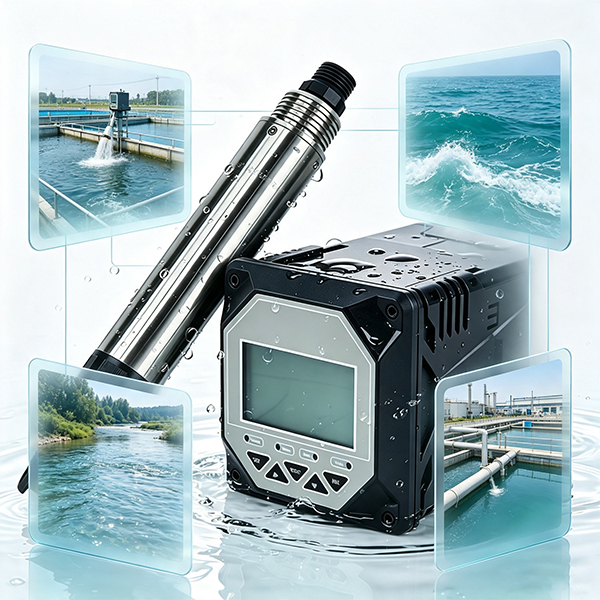
Different water environments impose distinct requirements on sensor resistance and anti-interference performance:
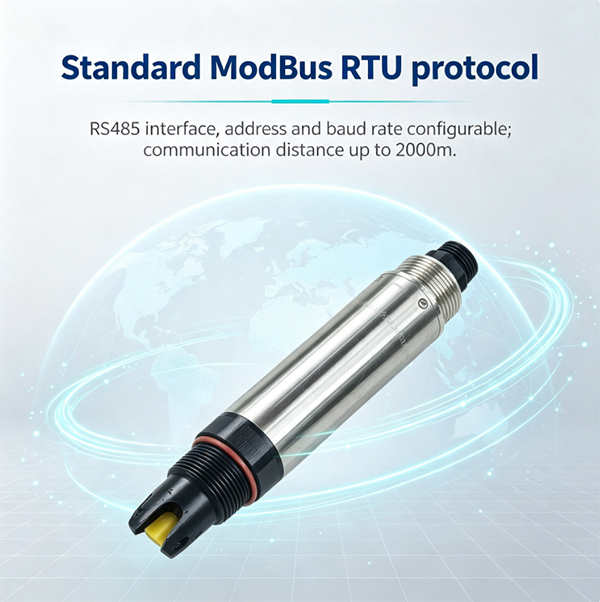
Besides, installation method matters. Submersible installation is widely adopted. Note sensor mounting angle requirements: vertical inversion and horizontal installation are usually prohibited; a tilt angle of at least 15° is needed to avoid air bubble accumulation. 316L stainless steel is recommended for the housing, and the protection rating shall reach IP68 to support long-term underwater immersion.
Suppliers shall provide complete quality documents, calibration certificates and a minimum one-year warranty. Consumables such as electrodes usually carry a shorter warranty (e.g., six months), yet the whole unit warranty shall not be less than 12 months. In addition, suppliers need to provide timely technical support and spare parts supply to guarantee long-term stable operation of monitoring systems.
Online nitrite sensor selection follows five steps: Measurement Principle → Performance Specifications → Scenario Adaptability → Communication & Maintenance → After-Sales Support. For most conventional online water quality monitoring projects, ISE sensors stand out for cost efficiency thanks to reagent-free operation, low maintenance and rapid response. Colorimetric or full-spectrum sensors can be adopted selectively for ultra-high precision demands or extreme operating environments. Ultimately, select the most suitable reliable product by combining budget, maintenance capacity and monitoring objectives.https://www.zonewuiot.com/rs485_c15

โทร : +86 18146178586
Whatsapp : +86 18146178586
อีเมล : qui@zonewu.com
เพิ่ม : 1501-3, Building F03, Phase III, Software Park, Jimei District, Xiamen City, Fujian Province, China